
5 minutes

How to Extend Refractory Lining Life in Coreless Induction Furnaces

Foundry operations using coreless induction furnaces for ferrous and non-ferrous melting. 

Foundry Solutions - Saint-Gobain

A refractory working lining protects the furnace shell and coil system from high temperatures, molten metal, slag, thermal cycling, and mechanical wear. Extending lining life requires more than selecting a material with a high maximum service temperature. The refractory must be compatible with the metal, slag, additives, furnace design, installation method, and operating cycle. 

In a coreless induction furnace, a zone-specific material strategy, disciplined installation and dry-out, controlled operation, and planned wear monitoring can reduce unplanned downtime and improve campaign consistency.
In Brief: Four Ways to Extend Refractory Lining Life 

  • Match the refractory to the molten metal, slag, additives, and furnace zone. 
  • Follow the product-specific installation, curing, and dry-out procedure. 
  • Control charging, temperature changes, stirring, and slag removal. 
  • Monitor wear and shell temperature so localized repairs can be planned safely.

Refractory wear rarely has a single cause. Coreless induction furnace linings may be exposed to thermal gradients, repeated heating and cooling, molten metal and slag, electromagnetic stirring, charging impact, and mechanical cleaning.

Failure mechanismWhat happensTypical contributing factors
Thermal shockCracking or spallingRapid heating, cooling, and temperature gradients
Chemical attackCorrosion, dissolution, or penetrationIncompatible metal, slag, fluxes, or additives
Mechanical wearAbrasion, erosion, or impact damageCharging, stirring, slag removal, and cleaning

Thermal Shock and Thermal Cycling

Thermal shock results from steep temperature gradients through the lining. Thermal cycling occurs during startup, shutdown, charging, production changes, and other repeated heating and cooling events. Both mechanisms create expansion and contraction stresses that can produce cracks, spalling, and weakened joints.

Material selection should reflect the furnace temperature profile and operating cycle. Saint-Gobain identifies thermal shock as one of the key stresses that working linings in induction furnaces must withstand.

Chemical Attack From Molten Metal and Slag

Molten metal, slag, fluxes, and additives can react with the refractory matrix. The resulting corrosion or infiltration may weaken the lining, change its dimensions, and increase the risk of metal leakage.

Refractory chemistry should be evaluated against the actual process. Acidic, basic, and neutral systems each have suitable applications, but compatibility must be confirmed for the specific alloy, slag chemistry, operating temperature, and furnace design.

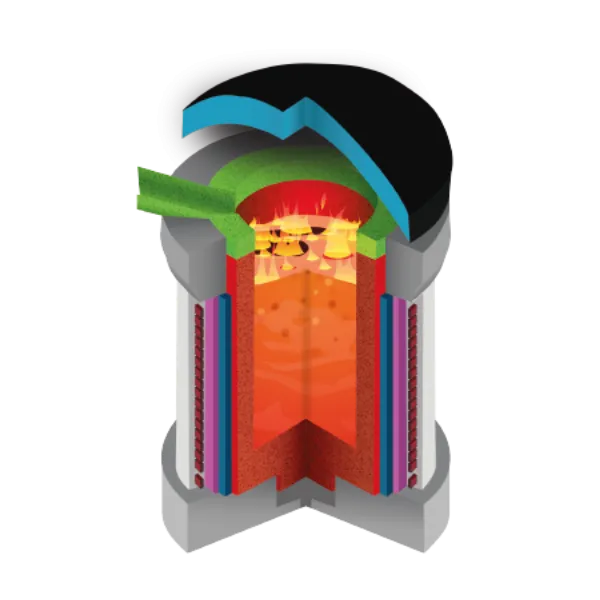
Saint-Gobain Performance Ceramics & Refractories Neutral Ramming Mass solutions form a jointless, multilayer working lining in selected coreless induction furnace applications. The company describes the three-layer structure as a way to support corrosion resistance, reduce metal infiltration, and enable controlled localized maintenance in suitable configurations.

Mechanical Wear, Abrasion, and Erosion

Mechanical wear occurs when charging materials, slag, tools, or moving metal physically remove refractory material. Heavy scrap can damage the hearth and lower walls, while stirring and turbulent flow can increase wear in other areas. Cleaning tools may also remove sound refractory together with dross or buildup. The lining design should identify high-impact and high-wear zones in advance. Even localized damage can determine the safe campaign length if it reaches a critical area near the coil or shell.

Three Practices for Extending Lining Life

1. Select the Right Refractory for the Application

Selection should begin with the furnace type and process conditions, not with a generic temperature rating. Consider:

  • Metal and alloy composition
  • Slag, flux, and additive chemistry
  • Maximum and normal operating temperatures
  • Furnace capacity and geometry
  • Charge quality, size, and impact potential
  • Holding time, stirring conditions, and production cycle
  • Required installation method and available drying equipment

Use a zoned design where appropriate. Working lining, coil coat, spout, top cap, patching areas, and other components may require different formulations or product formats.

Use fiber-reinforced or modified castables only when the manufacturer specifies them for the application. Expansion joints and allowances must follow the refractory system design.

2. Get Installation, Curing, and Dry-Out Right

Installation quality directly affects density, permeability, joint integrity, and mechanical strength. Surface preparation, mixing, compaction, curing, and dry-out should be controlled as one process.

  • Prepare the shell, substrate, anchors, and formwork according to the installation specification.
  • Use the specified water addition, mixing time, and compaction method. Excess water or inadequate consolidation can increase porosity and reduce strength.
  • Allow the installed material to cure under the conditions specified for its binder and thickness.
  • Use a product-specific dry-out schedule based on the manufacturer’s technical data sheet and the actual lining geometry.
  • Control ventilation and temperature measurement during dry-out and commissioning.

A controlled dry-out helps remove residual moisture and reduce the risk of steam-related damage, cracking, and premature spalling. No single heating rate or hold-point schedule is appropriate for every refractory system.

3. Control Furnace Operation and Monitor Wear

  • Avoid sudden temperature changes and uncontrolled cold-charge events.
  • Maintain stable charging, power, and stirring practices.
  • Control slag removal to limit chemical exposure and mechanical damage.
  • Adjust burners and combustion systems to avoid hot spots and excessive oxidation where applicable.
  • Record shell-temperature trends, lining observations, unusual events, and repair history.

Wear monitoring is more useful when it shows a trend rather than a single inspection result. Depending on the furnace and site procedures, inspections may include shell-temperature monitoring, visual inspection during shutdowns, dimensional mapping, or other non-destructive techniques selected by qualified personnel. 

Repair or Replace the Lining?

A localized repair may be considered when damage is confined to a defined area, surrounding material remains sound, and the repair method is approved for the lining system. A complete relining should be evaluated when wear is widespread, critical thickness has been reached, multiple areas are deteriorated, or lining integrity and safety cannot be demonstrated.

The decision must be based on the furnace design, refractory system, operating history, inspection data, and site safety procedures. Saint-Gobain Performance Ceramics & Refractories service model includes application engineering, inspection, installation, repair, and performance assessment for selected coreless induction furnace applications.

The Business Case for Longer Lining Life 

Longer refractory campaigns can reduce relining frequency, unplanned downtime, emergency labor, refractory consumption, and energy losses associated with damaged linings. The financial impact should be evaluated using the site’s production rate, downtime cost, energy consumption, maintenance history, and refractory usage. A higher-performance material may have a higher purchase price but a lower total cost of ownership when it improves campaign consistency, reduces repairs, or supports safer and more predictable maintenance planning.

foundry

How Saint-Gobain Performance Ceramics & Refractories Supports Foundry Operations

Saint-Gobain PCR provides refractory materials, lining solutions, application engineering, installation support, inspection, and optimization services for foundry equipment. Its foundry portfolio addresses coreless induction furnaces, inductors, ladles, pouring furnaces, cupolas, and other high-temperature equipment. For selected coreless induction furnace applications, the portfolio includes NORVIBE™, NORRAM™, NORTOP™, and NORCOIL™ solutions, as well as HeatKing™ Neutral Ramming Mass systems. Product selection and technical support are adapted to the furnace, metal, slag, capacity, and operating conditions.

Looking to improve your foundry performance?

Our experts can help you identify the right refractory solution for your process.