

Crash deck lining solutions for sinter plants are essential to ensure durability, safety, and performance in extreme industrial environments. Saint-Gobain Performance Ceramics & Refractories provides advanced refractory solutions designed to withstand high temperatures, severe impact, abrasion, and thermal shock, improving equipment reliability and reducing maintenance costs and production downtime.
-

-
Crash Deck Lining Solutions
for Sinter Plants -
What is a crash deck in a sinter plant?
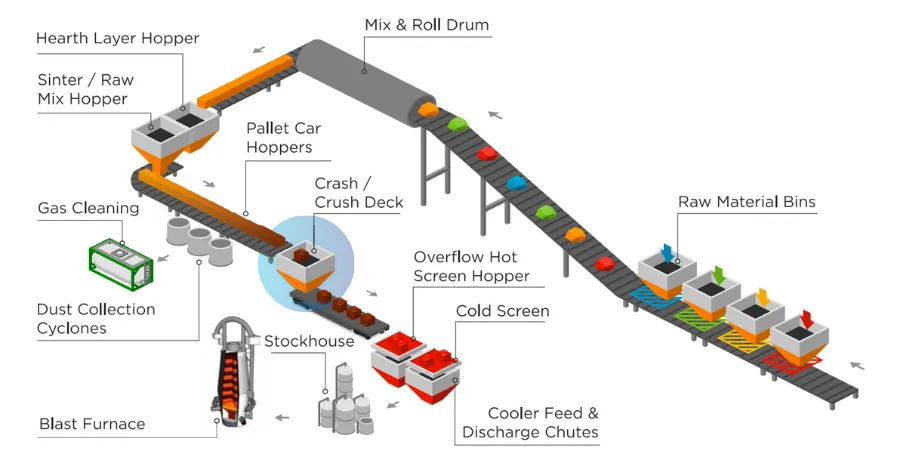
A crash deck is a critical component in sinter plants where hot sinter material falls before being conveyed to crushing and screening.
- Temperatures can reach 600–1000°C,
- Material falls from 2 meters or more,
- The surface must absorb high-impact loads and abrasion.
This makes the crash deck one of the most demanding applications in iron ore processing.
-
Key challenges in crash deck applications
Crash deck linings are exposed to a unique combination of constraints that must be managed simultaneously, including extreme impact loads generated by falling sinter, high temperature exposure combined with thermal cycling, and severe abrasion caused by iron ore agglomerates, all of which place strong demands on refractories structural integrity.
When these conditions are not properly addressed through adequate lining solutions, plants typically face recurring operational disruptions such as frequent shutdowns, increased maintenance costs, and a progressive loss of production efficiency.
-
Why choose Saint‑Gobain crash deck solutions
Saint-Gobain combines decades of expertise in sinter plant applications with advanced refractory technologies to deliver crash deck solutions proven to perform in the most demanding industrial environments, while being tailored to specific process conditions. Our advanced refractory materials are engineered to:
-
-
Absorb high-impact energy
Designed to withstand sinter falling from significant heights without structural damage.
-
Resist thermal shock and high temperatures
Maintain performance in environments exceeding 600–800°C and beyond.
-
Improve wear resistance
Mitigate abrasion from high-temperature iron
ore materials. -
Increased Process Reliability
Stable performance under severe abrasion and thermal shock.
-
Industry-Proven & Standard Solution
Adopted as a reference solution in modern sinter plants.
-
Extend equipment lifetime
Longer service life, Reduced downtime, Lower total cost of ownership.
-
-
Documents
-
-
FAQs
What is a crash deck in a sinter plant?The crash deck is the surface where hot sinter material lands after leaving the furnace and falling from height before entering crushing and screening processes.
Why is the crash deck area so critical?It combines extreme constraints simultaneously: high temperature, heavy impact, abrasion, and thermal shock, making it one of the most demanding zones in the entire sinter process.
What temperature and conditions must the lining withstand?Crash deck linings typically face:
- Temperatures ranging from 600°C to over 800°C, with localized spikes,
- Impacts from sinter falling from several meters,
- Continuous abrasion from iron ore material.
How do Saint-Gobain PCR solutions improve performance?They use advanced refractory materials produced by electrofusion and engineered for:
- Unmatched resistance to impact and wear at high temperatures,
- Improved thermal shock resistance,
- Longer service life compared to conventional linings.
Can these solutions reduce maintenance costs?Yes, by extending lining lifetime and reducing failures, they significantly lower maintenance frequency, shutdowns, and overall operating costs.