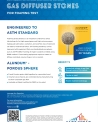
Gas diffusor stones for foaming test
-
-
Ceramic Labware
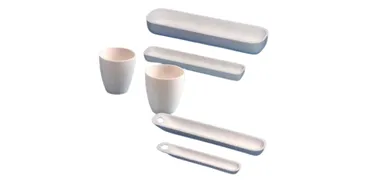
Made from high-purity Alundum® alumina, labware products stand up to thermal shocks and the harsh chemicals commonly encountered in laboratories. Product durability ensures precise and repeatable results in weighing, melting, and combustion tasks.
Saint-Gobain Performance Ceramics & Refractories produces ceramic labware built to perform in environments where high temperatures, corrosive chemicals, and mechanical stress are routine. Crafted from high-purity materials, such as alumina, silicon carbide, alumina mullite, and zirconia-based compositions, our ceramic labware displays exceptional thermal stability, chemical resistance, and durability. Laboratories, universities, research centers, and industrial facilities rely on our ceramic labware to deliver accurate results and consistent performance, with each piece produced using precision processes, rigorous quality standards, and materials engineered for dimensional stability and long service life.
-
Engineered Solutions
The materials used to form our ceramic labware and labware equipment are chosen for their ability to withstand elevated temperatures and corrosive substances, while maintaining structural integrity in demanding operating environments, making them ideal for long-lasting equipment.
- Alundum® High-Purity Alumina Labware – Made from 99% fused Al₂O₃, Alundum® resists temperatures up to approximately 1450 °C under continuous use and resists most acids and alkalis (excluding hydrofluoric acid and concentrated phosphoric acid). Its strength and stability ensure suitability for repeated exposure to high-temperatures and help reduce contamination risks in sensitive processes. Alundum®products include, combustion boats with and without handle, dishes, thimbles, crucibles, filter discs and cones.
- Hexoloy® SA Sintered Silicon Carbide Labware – Produced from single-phase α-SiC, Hexoloy® SA offers extremely low porosity, high thermal conductivity, exceptional resistance to corrosion and thermal shock, and continuous service up to 1,650°C in air. We manufacture a variety of ceramic labware from this material, including crucibles, reaction vessels, and thermal transfer components designed for aggressive chemical environments or processes involving rapid temperature changes.
- AnnaMullit® Alumina Mullite Labware – Composed of alumina and mullite, AnnaMullit® exhibits excellent mechanical strength, thermal shock resistance, and stability at elevated temperatures. It can be used to fashion ceramic labware like setters, saggers, and capsules that perform reliably in corrosive atmospheres.
- Zirnorite® Zirconia-Based Ceramic Labware – Formulated from zirconia-based ceramics, Zirnorite® provides outstanding corrosion resistance, insulation, and high temperature performance when exposed to molten metals, glass, and aggressive chemical media.
- Alundum® Porous Sphere Labware – Manufactured from high-purity alumina with an extensive surface area and excellent chemical inertness, Alundum® porous spheres serve as key components in our ceramic labware for measuring foaming tendency of lubricating oils. Alundum Porous Spheres are available as Rated (certified) or Un-rated.
- Alundum® High-Purity Alumina Labware – Made from 99% fused Al₂O₃, Alundum® resists temperatures up to approximately 1450 °C under continuous use and resists most acids and alkalis (excluding hydrofluoric acid and concentrated phosphoric acid). Its strength and stability ensure suitability for repeated exposure to high-temperatures and help reduce contamination risks in sensitive processes. Alundum®products include, combustion boats with and without handle, dishes, thimbles, crucibles, filter discs and cones.
-
Material Grades and Performance Characteristics
Below are the grades, compositions, and operating properties of our available ceramic labware materials to aid in identifying the most suitable option.
Grade Approx. Particle Retention Size Apparent Porosity Composition Maximum Use Temperature Coeff. of Thermal Expansion
(30 - 1,500°C)Approx. Electrical Resistivity Effect of Atmosphere Alundum® AN-788
Fine 0.1 micron 35% 91% Al2O3 1,450°C 8.6x10⁻⁶ 130.0 Megaohms at 530°C
16.0 Megaohms at 730°C
5.3 Megaohms at 890°C
1.5 Megaohms at 1020°COxidizing: None
Reducing: Reduction of bond constituents above 1,400°C
Effect on Acids: None except HF and concentrated H3PO4
Effects of Alkalies: None except strong hot caustic solutions and fused alkalies
Alundum® AN-889 Medium 5.0 microns 42% 85% Al2O3 1,450°C 8.6x10⁻⁶ Alundum® AN-485 Coarse 20.0 microns 47% 85% Al2O3 1,450°C 8.6x10⁻⁶ Zirnorite® YN-756 25% 92.6% Al2O3 1,590°C 5.5x10⁻⁶ High -
Product
Alundum Labware
Discover Saint-Gobain Performance Ceramics & Refractories’ extensive range of ceramic products for laboratory operations and analytical instruments.
ProductHexoloy Custom Shapes
Discover Saint-Gobain Performance Ceramics & Refractories’ extensive range of silicon carbide technical ceramics.
ProductZirnorite Refractory Shape
Discover Saint-Gobain Performance Ceramics & Refractories’ range of Zirnorite® zirconia refractory products - extreme high-temperature stability and...
-
Document
-
FAQ
Does labware from Saint-Gobain Performance Ceramics & Refractories remain chemically resistant and stable when in contact with reagents and solvents at high temperature?Saint-Gobain Performance Ceramics and Refractories’s Alundum Al2O3 and Zirnorite Zircon labware products are resistant to most acids and alkalies, except for HF, concentrated H3PO4, strong hot caustics and fused alkalies. Hexoloy SSiC products offer excellent corrosion resistance to a wide range of acids and bases.
What type of materials are used by Saint-Gobain Performance Ceramics & Refractories for laboratory applications?Typical materials include sintered silicon carbide, recrystallized silicon carbide, alumina mullite, and fused alumina.
Does Saint-Gobain Performance Ceramics & Refractories offer porcelain labware?No.
-
Speak to an Expert
Our specialists are ready to provide you with more detail about our ceramic labware.