
• total-burner-solutions.png
  • Single Ended Radiant Tube

    Single Ended Radiant Tube

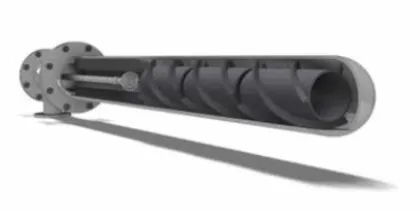
    The single ended radiant tube’s straight tube-in-tube design is comprised of thin-wall ceramic and alloy material with integral self-recuperating capabilities.

    Its compact design is optimized for heat transfer and heat output with minimal losses.

    The use of Saint-Gobain Performance Ceramics & Refractories‘ Silit® materials ensures that ceramic radiant tubes, recuperators, flame tubes and combustors deliver reliable, time-tested performance in line with industry standards.


    Employing the ceramic radiant tube in conjunction with the twisted channel HeatCor™ recuperator, twisted tape PyroCor™ flame tubes, and 3D printed burner tips can lead to efficiencies of up to 85%, twice the heat release of traditional metallic tubes, optimum temperature uniformities and minimum NOx.

    • 2
      X
      heat dissipation
    • 70
      up to 80%
      efficiency
    • 2
      x
      service life
  • Features and Benefits

    • Made of robust silicon carbide
    • Operating temperatures up to 1,350°C
    • Long service life
    • Advanced silicon carbide microstructures provide high thermal conductivity and shock resistance
    • Traditional (Silit®) and additive manufactured (Amasic-3D®) designs can accommodate a range of cost and performance targets
    • Thin-wall designs increase thermal performance and enable design flexibility
  • FAQ

    What are the maximum dimensions for ceramic radiant tubes?

    The maximum dimensions are 300 mm in diameter and 3,500 mm in length. Radiant tubes can be customized to accommodate customer-specific mounting requirements.

    What is the difference between ceramic and metal radiant tubes?

    Ceramic radiant tubes made from Silit® provide twice the heat transfer rate (50 kW/m2 – 1,050°C) of a standard metallic radiant tube. Ceramic radiant tubes do not require bending, meaning their service life is longer versus a metallic tube.

    What are the material properties of Silit® and Amasic-3D™?

    These infiltrated SiSiC high performance, non-porous ceramic materials can accommodate application temperatures of 1,380°C. They also offer excellent thermal strength properties.

    What is the maximum application temperature for Silit® ceramic radiant tubes?

    The maximum application temperature is 1,380°C.

    How does PyroCor™ work?

    PyroCor™ utilizes a specialized design and variable twists to optimize temperature uniformity in the radiant tube.

    What is different between HeatCor™ and a standard recuperator?

    The HeatCor™ technology’s use of hollow channels and the resultant larger inner surface area results in an increase of up to 80% efficiency versus a standard ceramic recuperator.

    What is the minimum wall thickness possible with Silit® and Amasic-3D™?

    The thinnest possible wall thickness is approximately 4 mm with Silit® and 2 mm with Amasic-3D™.

    What is the LHV efficiency of this solution?

    Depending on what the customer's needs are related to NOx levels, we can approach 85% percent. Typically, we're in the high 70s to low 80%.

    We have seen some of the trials from POSCO were in the range of like 77 to 81% LHV.

    How does modelling affect the qualification times and what resources does Saint-Gobain Performance Ceramics & Refractories have to support modeling?

    Modelling efforts depend on their complexity and scope. They can take a few hours or up to several months. By taking the time to study the application upfront, we have seen in our experience, customers can dramatically eliminate potential delays and pains during in furnace qualification.

    In terms of modelling resources, Saint-Gobain currently has two teams, one based in the US and one based in France at our R&D centers that can support computational fluid flow modelling. Our French team have a lot of experience with combustion simulations. Saint-Gobain is actively involved with glass production and glass melting. So, for that application, combustion is critical, and we have experts that are knowledgeable in combustion applied to both glass melting and steel reheating.

    Can the technology to be applied to burners of other manufacturers?

    The NOxBuster can be applied in Push, Push-Pull, and Pull systems. The pressure drop is very low on the NOxBuster. We would say four years ago, it was limited to one or two burners. Today, because of the resources of the computational modelling and the testing, Saint-Gobain Performance Ceramics & Refractories is finding that it's applicable to a variety of different manufactured burners. To date, we have tested it on at least five or six different burners with very similar results. And the nozzle mix, partial premix, both air-staged and gas-staged combustion, as well as low-NOx burners, and it was used both with exhaust gas recirculation and without.

  • Need Help Finding the Right Solution?

    Our team is here to guide you. Let us help you choose the best option for your needs.