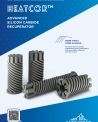


Silit® recuperators can be integrated into total burner systems for both direct and indirect heating applications. They can be installed into every type and size of radiant tube. The recuperator recycles energy, with these traditional ceramic recuperators facilitating efficiencies of up to 75% in more sophisticated systems.
HeatCor™ and Silit® Recuperators
The HeatCor™ twisted channel recuperator is a heat exchanger technology enabled by the Amasic-3D® manufacturing platform.
HeatCor™ allows recuperators and burner systems to exceed 80% efficiencies thanks to its unique twisted channel design and surface areas up to three times larger than traditional recuperators with the same footprint.
Ceramic Recuperators' Features and Benefits
Benefits
- Made of robust silicon carbide
- Operating temperatures up to 1,380 °C
- Long service life Advanced silicon carbide microstructures provide high thermal conductivity and shock resistance
- Industry-leading diameter and length
- Suitable for most furnace applications
- Thin-wall designs increase thermal performance and enable design flexibility
Benefits
- Thin-wall silicon carbide offers the highest rates of heat transfer and thermal performance
- Variable twist and channel cross-section provides optimized efficiency with the lowest pressure drop
- Novel metal-ceramic interface ensures easy integration into metallic furnace components
- 3D printed end-sets improve application flexibility and extend customization potential
- A picture containing diagram
- Description automatically generated
HeatCor™ Recuperator
FAQ
What are the material properties of Silit® and Amasic-3D™?
These infiltrated SiSiC high performance, non-porous ceramic materials can accommodate application temperatures of 1,380°C. They also offer excellent thermal strength properties.
How does the HeatCor™ work?
The HeatCor™ is a new heat exchanger design that incorporates a higher surface area twist channel versus traditional fins and bumps. This increased surface area allows for an increase in effectiveness of over 10%.
Is it possible to print threaded connections?
Yes. A variety of threaded connections can be 3D printed via the Amasic-3D® material platform. Coarse threads are typically preferable.
What is the difference between Silit®, Silit HD® and Hexoloy®?
The key difference of Silit® SKD, Silit® SKD-H and Hexoloy® is the range of application temperatures which can be accommodated. Hexoloy® is 100% SiC while Silit® has a percentage of silicon in the matrix. This allows Hexoloy® to operate at temperatures exceeding 1,800°C.