
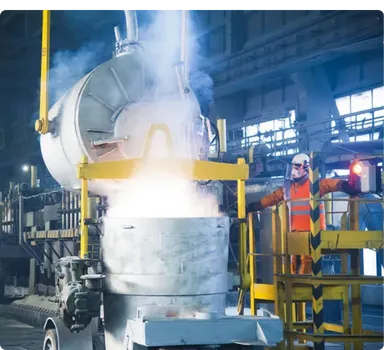
Melting furnaces are used to melt scrap or recycled aluminium, requiring a high heat input since the roof temperature can exceed 1,100°C. Holding furnaces receive molten metal from either the primary reduction potlines or from the melting furnaces. They operate at lower temperatures. Alkali chlorides and fluorides are often used as flux, to avoid bath oxidation and to help remove impurities in melting furnaces. These salts are very aggressive to the refractories.
Molten aluminium is able to reduce many oxides found in the refractory linings, such as SiO2, Fe2O3, TiO2 to their metallic state. The by-product of this reaction is corundum. The accumulation of corundum on the refractory lining presents a major problem in melting furnaces.
A combination of oxy-nitride bonded SiC bricks (Cryston® CN190 and CN806 oxy-nitride bonded SiCs) and low porosity, chemically bonded Alfrax® PB110 alumina bricks offers an optimal cost-performance compromise for ramp and hearth lining. Saint-Gobain also provides nitride bonded SiC Refrax® 20 and Cast Refrax® tap out blocks, throat inserts and stopper rods.