
• total-burner-solutions.png
  • U-TUBE

    U-Tube

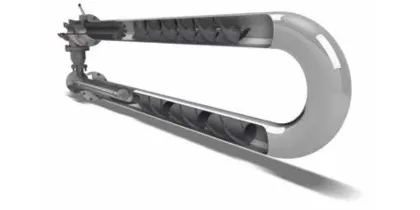
    Radiant U-tube combustion systems are an industry standard for the indirect heating of metals in a protective atmosphere. The U-tube, modular burner, and plug-in type recuperator typically operate at temperatures up to 1,000°C and efficiencies of 70%.


    Leveraging the power and reliability of Saint-Gobain Performance Ceramics & Refractories’ twisted channel HeatCor™ recuperator, twisted tape PyroCor™ flame tube, SpyroCor® radiant tube insert, and NOxBuster® internal exhaust gas recirculatory can enable increased throughput, energy savings, reduced emissions and lower maintenance frequencies.

    • 2
      to 6%
      Throughput Improvements
    • 5
      to 20%
      Energy Reduction
    • 5
      to 50%
      NOx Output
  • Features and Benefits

    • Made of robust silicon carbide
    • Operating temperatures up to 1,350°C
    • Long service life
    • Thin-wall twisted geometries improve heat transfer
    • Optimized efficiency Improved temperature uniformity
    • Thermal shock resistant microstructure
    • Effective thermal cycling in high temperature environments
    • Computationally modeled thermal designs optimize NOx and carbon reduction within the radiant tube
  •   Radiant Tube System  
      Single Ended Tube U-Tube W-Tube Brand
    Silit Products

    1,350°C thermal shock resistant
    Slip cast
    4 - 6 mm thickness
    0% porosity

    1,350°C thermal shock resistant
    Additive manufactured, 3DP
    2 - 4 mm thickness
    0% porosity

    Amasic-3D®
      ......Improvement  
    Ceramic Radiant Tube 2x heat release 5 - 15% throughput, energy, emmissions SpyroCor®
    Recuperator 70 - 75% efficient 75 - 85% efficient HeatCor™
    Flame Tube 2x life 10 - 25% uniformity PyroCor™
    Combustor finned surface 10 - 50% NOx Reduction NOx Buster®


  • FAQ

    What is a twisted channel HeatCor™? 

    The HeatCor™ is a new heat exchanger design that incorporates a higher surface area twist channel versus traditional fins and bumps. This increased surface area allows for an increase in effectiveness of over 10%.

    How does PyroCor™ work?

    PyroCor™ utilizes a specialized design and variable twists to optimize temperature uniformity in the radiant tube.

    What are the material properties of Silit® and Amasic-3D™?

    These infiltrated SiSiC high performance, non-porous ceramic materials can accommodate application temperatures of 1,380°C. They also offer excellent thermal strength properties.

    What is the minimum wall thickness possible with Silit® and Amasic-3D™?

    The thinnest possible wall thickness is approximately 4 mm with Silit® and 2 mm with Amasic-3D™.

    How does modelling affect the qualification times and what resources does Saint-Gobain Performance Ceramics & Refractories have to support modeling?

    Modelling efforts depend on their complexity and scope. They can take a few hours or up to several months. By taking the time to study the application upfront, we have seen in our experience, customers can dramatically eliminate potential delays and pains during in furnace qualification.

    In terms of modelling resources, Saint-Gobain currently has two teams, one based in the US and one based in France at our R&D centers that can support computational fluid flow modelling. Our French team have a lot of experience with combustion simulations. Saint-Gobain is actively involved with glass production and glass melting. So, for that application, combustion is critical, and we have experts that are knowledgeable in combustion applied to both glass melting and steel reheating.

    What is a typical lifetime of a spiral device?

    The usual failure mode of the SpyroCor is related to the tube life. A radiant tube will last maybe three to five years, or longer. As the radiant tube fails, it can capture the SpyroCor in the tube. Some customers will remove the SpyroCor before that happens, and we've seen two to three tube changes. Thus, typically greater than 10-year life on the SpyroCor system.

    What is the final NOx performance of this solution ppm at 3% oxygen?

    The NOx level during HeatCor trials increased to 200-250 ppm in the NOx cluster brought that down to <120 ppm (corrected to 3% - O2). We also have other cases, where recuperation wasn't used, and we have gone from in the range of 90 - 100 ppm at 3% oxygen, down to between 30-40 ppm of NOx at 3% oxygen.

  • Need Help Finding the Right Solution?

    Our team is here to guide you. Let us help you choose the best option for your needs.