
Process monitoring is a challenge in glass and metal foundries. Sampling melt or flue gas temperatures means exposing sensitive probes to high-temperature, corrosive environments.
Thermocouples are used across the full spectrum of engineering and industry to obtain accurate temperature readings in situ. This is calculated as a function of the temperature differential at a junction between two temperature-sensitive wires—usually chromel-alumel, or what is known as a Type K thermocouple.
Although reliable and accurate at temperatures over 1,000°C (1,832°F), thermocouples are prone to corrosion in harsh atmospheres and cannot withstand the severe thermal shock associated with foundry applications. Additionally, the accuracy of temperature readings is relative to the dimensional integrity of thermocouple wires, meaning there is low tolerance for thermally-induced expansion.
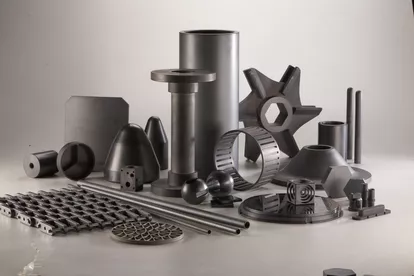
An easy solution to this problem is to sheathe thermocouples in a protection tube composed of a technical ceramic like alumina, silicon carbide, or zirconia.

